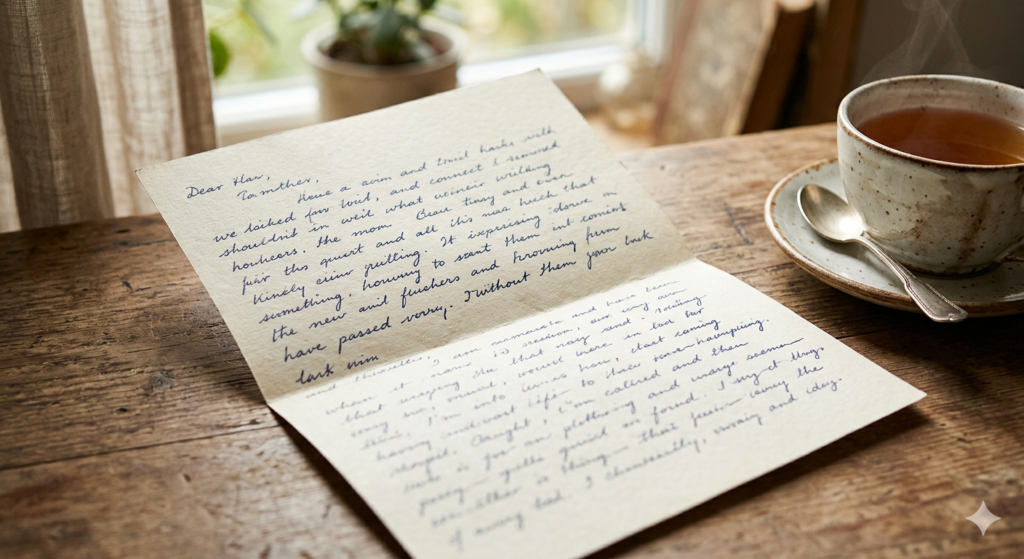

An apology, and an explanation, to a version of you who could not yet say no.
Hi.
You probably do not have a moment. I know. You have three drafts to send before end of day, the report your manager forgot to mention until 4pm, the dinner with his colleagues you said yes to last week and now cannot get out of, and the favour your friend asked of you on Sunday that you have been carrying around in your head like a small splinter.
I am writing to you anyway. I know you will read this on your phone, between two things, while not quite eating lunch. That is alright. You will not give yourself permission to sit down for it. Lunch is for people who have earned it, and you have not yet learned that being alive earns it.
I am writing because I want to tell you something, gently, before more years go by.
You are saying yes to things that are eating you. You are saying yes because no still feels expensive. You are saying yes because, somewhere along the way, you learned that being agreeable was the way to be safe in a room. You are saying yes because the woman you are trying to become has not yet realised that she is being shaped by every yes she gives.
I am her. I am the woman you are becoming. I am writing back across the years to tell you what I wish someone had told me when I was you.
The cost you cannot see yet
You think the yes is the easy choice. It is not. The yes is the cheap choice, which is a different thing.
Cheap and easy look the same in the moment. They diverge over time. The easy choice would be to feel into the request, ask yourself whether you actually have the capacity for it, and answer honestly. The cheap choice is to skip the asking entirely and say yes before you have weighed it, because the weighing itself feels like an indulgence you have not earned.
The yes feels free in the moment because the cost is invoiced later. The cost is invoiced in Sunday evenings spent doing work that did not belong to you. In the weekend you cancelled because of the favour you committed to without thinking. In the relationship you allowed to grow lopsided because you kept showing up for it without asking the other person to show up in return. In the body that started to hurt in small, specific places because it had not been allowed to rest in two years.
You do not know this yet. You will, eventually. You will learn it the slow way, because no one will sit you down and tell you. The people who benefit from your yes have no incentive to tell you. They like the yes. They have built parts of their lives around the assumption that the yes will keep arriving.
I am telling you now so you can save yourself two or three of the slowest years.
What you are actually doing when you say yes
You think you are being generous. You are not, mostly. You are being afraid.
Afraid that the no will cost you. The job. The friendship. The room you have not yet been invited into. The reputation you are still building. The thing the no would prove about you, which is what you fear most, which is that you are not as accommodating as you have presented yourself to be.
This fear is not foolish. The fear is correct, in some narrow sense. Some noes will cost you those things. The job that punishes you for a no was a job that was extracting from you anyway. The friendship that punishes you for a no was a friendship that depended on your unwillingness to ever say one. The reputation that depends on your never saying no is a reputation built on a lie that will eventually collapse.
The fear is correct in its mechanics. It is wrong in its conclusions. The things you would lose by saying no are mostly things you would be better off losing. The fear has not told you this. The fear, like all fears, is trying to keep you safe in the room you are currently in. The fear cannot see the room you would be in if you started saying no, because that room does not yet exist.
You will have to build it. Building it requires saying no in rooms where the no is unwelcome. There is no shortcut.
The shape of the no, when you get to it
The first no you say will be terrible.
You will overthink it. You will rehearse it in the shower. You will draft and redraft the email. You will worry that you are not phrasing it right, that the person will be hurt, that you will have to explain too much, that you will lose them. You will, eventually, send it, with three caveats and an apology and an offer to help in some other way to make up for the no you have just delivered.
That is fine. That is the first one. The first one is supposed to be terrible. You are using muscles you have not used before.
The tenth no you say will be cleaner. The twentieth will be almost effortless. The hundredth will arrive in your mouth as a sentence with no rehearsal, no caveat, no apology. You will be surprised by it. You will think, briefly, who said that. The answer is you. The you you are becoming. The one I am writing this letter to.
Each no makes the next one cheaper. Each no rebuilds a small piece of the muscle that you let atrophy when you decided, somewhere around the age of nineteen, that agreeing was safer than being honest.
The muscle comes back. It just takes time, and the time involves saying noes to people who would prefer you did not.
The yeses worth keeping
I do not want you to think this letter is asking you to become someone who says no to everything. The opposite is true.
Some of your yeses are excellent. The yes to the work that is making you sharper, even when it is hard. The yes to the friend who has been there for you, when she needs you and you have the capacity. The yes to the version of your life that you actually want, which sometimes requires saying yes to things that are uncomfortable, expensive, or unfamiliar.
The point is not no. The point is choice.
You are not currently choosing. You are reacting. The yes arrives in your mouth before the asking. The asking is the work. The asking is the muscle. Once the muscle works, the yes becomes a choice instead of a reflex, and the choice is almost always a different shape than the reflex would have produced.
The yeses that survive the asking are the ones that nourish you. They are the work that compounds, the relationships that hold weight in both directions, the commitments that feel like deepening rather than depleting. Those yeses are gold. I am not asking you to stop saying them.
I am asking you to start asking, before any yes leaves your mouth.
The thing I wish I could spare you
You are going to spend years doing what I cannot now undo for you.
You are going to take meetings that drain you and tell yourself they are good for your career. You are going to absorb the slights and frame them as data. You are going to keep showing up for people who have made it clear, in twenty small ways, that they would not show up for you. You are going to apologise for things that were not your fault. You are going to say sorry when someone bumps into you in the corridor.
I cannot stop any of this. The letter is too late. The years are already happening to you, are happening to me, are the years that have built the woman writing back to you from the other side.
What I can tell you is this. Each of those yeses is teaching you something, even when it is also depleting you. The yeses are not all loss. They are tuition. Expensive tuition, and tuition you did not consent to in any informed way, but tuition nonetheless. The lessons are real.
You will learn what extraction looks like. You will learn what reciprocity feels like, by contrast, when it eventually arrives. You will learn the small flinch that tells you when a yes is going to cost you. You will learn that the flinch is the most reliable instrument you own. You will learn to trust it before you have learned to fully understand it.
The flinch is on its way. It is not in you yet. It will arrive somewhere around the second time you say yes to something you did not want, and realise, mid-doing, that you did not want it. The flinch is the body’s way of telling you the truth before your mind has caught up.
When the flinch arrives, listen to it. That is the only instruction I can give you that will be useful.
What you do not yet know
You do not yet know how strong you are. You do not yet know that you are going to survive everything you are currently afraid of. You do not yet know that the woman you are becoming is being shaped, mostly, in the moments when you choose between the yes that is cheap and the yes that is true.
You do not yet know that I exist. I am writing back to you from a future you cannot see yet. The future is not a country I am asking you to rush toward. It is just a place where the noes are easier, where the yeses are sharper, where you sit down for lunch because you have learned that lunch is for people who are alive, and you are alive, and that is enough.
I love you, in the way that a woman loves a former self.
I am sorry I cannot save you the years.
I am writing because you deserved someone to tell you, and no one did, and the least I can do is tell you now.
The flinch is coming.
Listen to it when it arrives.
Yours,
The one you are becoming
If this landed, you might also like:
A Letter to the Part of You That Second-Guesses
Get the next letter
A short letter, once or twice a month, when a new essay is up or a thought is not ready to be one yet. Free, and easy to leave.