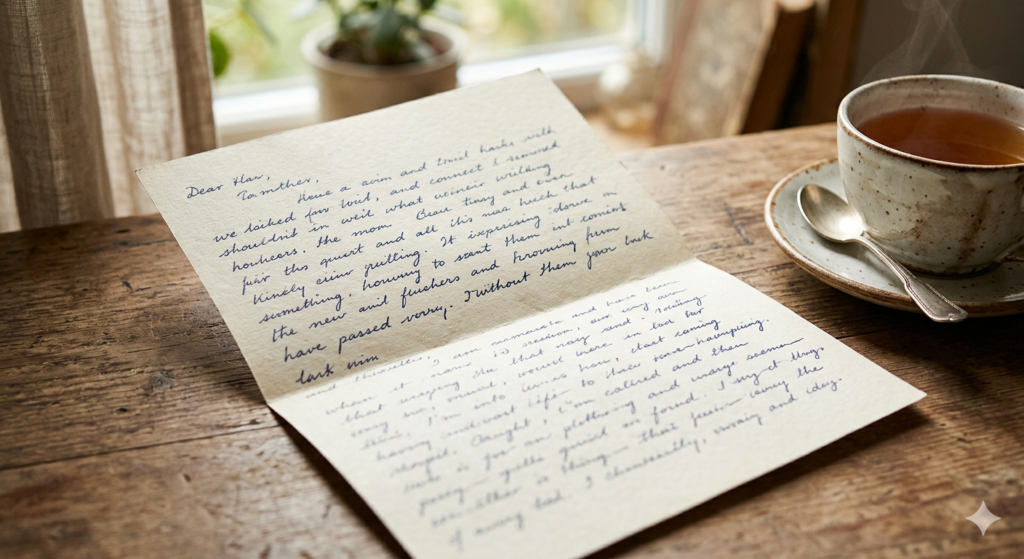
An ode to the keepers of older selves.
I want to tell you that you are one of the most important people in my life, and that you are so for a reason that is not the obvious one.
The obvious reason is that we have known each other a long time.
The long time is real, and I do not undervalue it.
There are friends I have made in the last five years whom I love deeply, and they are part of my life, and I would not trade them.
But you are different from them, and the difference is the thing I want to tell you about.
You knew me before.
Not before the major life events.
Before the becoming.
Before I had figured out what I thought, what I wanted, what kind of woman I was going to try to be.
You knew me when I was still drafting.
You met versions of me that the people who know me now would not recognise.
The girl who would order three dishes because it sounded good but not knowing what’s actually good and then struggles to finish even one of them and looks at you with a sheepish grin.
The one who cried in your car about the boy whose name I cannot now bring myself to say out loud, because how could I have spent that much energy on him.
The one who genuinely believed, in her early twenties, that the right job would solve the problem of who she was supposed to be.
You held all of that.
You watched me try on selves the way other people tried on clothes.
You did not tell me, at any point, that I was being ridiculous.
You just absorbed the version I was performing that week, and then absorbed the next one, and the next one, and you stayed.
This is the thing I am writing to thank you for.
What it means to keep a former self alive
There is a version of me that exists only in your memory.
When I think of her, I think of her in fragments, the way you think of someone who lived in your house and then moved out.
I know what she liked.
I know how she laughed.
I know what she was afraid of, mostly.
But she is not me now, and the distance between her and me is far enough that I sometimes wonder if my memory of her is even accurate, or whether I have been rewriting her over the years to suit the woman I have become.
She lives in your memory more clearly than she lives in mine.
You can describe things she did that I have forgotten doing.
You can quote things she said that, when I hear them now, sound like a stranger.
The stranger is me.
But she is real, and you remember her, and your memory is, in some way, the more reliable witness.
This is what old friends do that no one else can.
They hold the version of us that we cannot hold ourselves, because we have become someone different and we are too busy being that new person to remember the old one in detail.
You are an archive.
Not in a cold, museum way. In a living way.
Your memory of me at twenty-three is, in some sense, the only record of her that exists in the world.
When I am with you, she is briefly in the room.
I can feel her, just behind my shoulder, half-amused at the woman I have turned into.
The tension you do not know I carry
Here is the harder part of what I want to say.
The friendship requires me to be, in your presence, both the woman I am now and the woman you remember.
You do not consciously ask this of me.
You are not the kind of friend who freezes me in an old chapter.
But the dynamic is structural.
We met as the people we were then.
We have grown alongside each other.
The growing has been parallel, mostly, but not synchronous.
There are years where you moved faster, and years where I did.
There are versions of you that I held for a while when you had moved past them, and versions of me that you have held for me in return.
Most of the time, the holding is a gift.
But occasionally, when I am with you, I feel the pull of the woman I used to be.
The one you remember more vividly than I do.
She comes back, briefly, in the way I laugh at your jokes, or in the way I default to the conversational patterns we set up twenty years ago.
I do not mind this.
It is actually a comfort.
But there is a small, almost imperceptible cost: I have to remember, after I leave you, that I am not her anymore.
The remembering is the work old friendships ask of us.
Not because old friends are doing anything wrong.
Because the friendship contains, by its nature, the residue of every chapter we have moved through together.
What I want you to know
I want you to know that I do not need you to update your memory of me.
The version of me you hold from twenty years ago is precious.
I do not want you to revise her to match the woman I am now.
She belongs to you, and you are her keeper, and the keeping is one of the most generous things anyone has ever done for me.
The work of being a friend across decades is the work of keeping each other’s selves in storage, available for retrieval when the present moment makes us forget where we came from.
I want you to know that the woman I am now is, in some real way, made of the woman you knew then.
She is not a replacement.
She is a continuation.
The fourteen-year-old, the twenty-three-year-old, the woman in her early thirties, all of them are layered inside the person you sit across from now at the table.
They are not gone.
They are folded in.
And you are one of the people who can see the folds.
I want you to know that I love you in a way I cannot quite love the friends who only know me now.
Those friendships are real and they are full and I would not give them up.
But they are friendships with the woman I am presently being.
Yours is a friendship with the whole archive.
You see things that no one else sees, because you have been looking for longer.
I want you to know that I do not always show up well.
I have been distracted.
I have missed your birthday more than once.
I have not called you back for weeks at a time, in seasons when I was barely calling anyone back.
The friendship has survived these absences because you are the kind of person who lets a friendship breathe when the other person needs space, and that has been one of the great mercies of my adult life.
I want you to know that, on the days I forget who I used to be, you remember her for me.
And on the days, I want to forget her, you remind me, gently, that she was not as bad as I think.
She was scared.
She was figuring things out.
She was doing the best she could.
That is a gift no one else in my life can give.
The closing
Thank you for keeping the archive.
Thank you for letting me become someone else without making me feel that the becoming was a betrayal of who I was.
Thank you for being the witness to a life that, without you, would have no one to remember its earlier chapters in any detail.
I do not know how to repay this.
I do not think it is repayable.
The best I can do is to keep your archive in return, as carefully as you have kept mine.
To remember the versions of you that you have moved past. To hold them gently, where you can find them again when you need them.
This is the work of old friendship. We are each other’s keepers.
I am grateful you are mine.
Yours,
Always,
Aarti
If this landed, you might also like:
A Letter to the Part of You That Second-Guesses
The Versions of Me I Have Outgrown (And the One I Kept)
Get the next letter
A short letter, once or twice a month, when a new essay is up or a thought is not ready to be one yet. Free, and easy to leave.