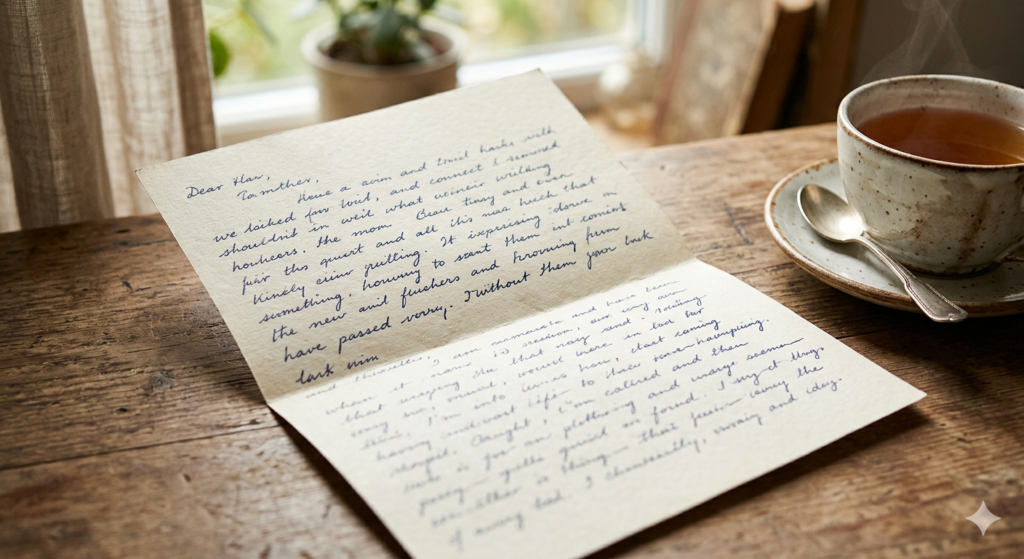

An address to a self who outsourced solitude.
Hi.
I want to talk to you about the silence.
You used to have it.
You may not remember.
You were younger then, in a way that has nothing to do with your age.
You used to sit in the car at the supermarket for ten minutes before going in, with the radio off and the phone face-down on the passenger seat, and you would just sit.
You would notice things.
The colour of the sky.
The way the wind moved a plastic bag across the car park.
The thought you had been not-having for two weeks, finally finishing itself in your head.
You did not call that solitude.
You did not call it anything.
It was just a thing that happened in the gaps of your day, and the gaps were small but they were yours.
Then, slowly, the silence got crowded.
I am not sure exactly when it started.
It was not one decision.
It was a thousand small ones.
You started listening to a podcast on the school run.
Then on every drive.
Then in the shower.
Then while cooking.
Then while walking.
The podcasts were good.
The information was useful.
You learned things.
You were never bored.
You also, somewhere in the accumulation, lost the ten minutes in the car at the supermarket.
You lost the gap before bed.
You lost the small windows in the day when you used to be alone with the inside of your own head.
I am writing because I want to tell you what you lost when the silence got crowded, and what it looks like to get it back.
The thing the silence was doing
You did not know this at the time, but the silence was doing work.
The unstructured time, the gaps, the ten minutes in the car, were where your mind metabolised the day.
Where the thought you had not finished the finish itself.
Where the small worry that had been buzzing at the edge of your attention got a chance to come forward and either resolve or get named.
Where the deeper observation, the one that needed quiet to assemble, assembled.
The neuroscientists have a name for this.
They call it the default mode network.
The brain has two modes: a focused mode, when you are paying attention to a specific task, and a default mode, when you are not.
The default mode is where memory, future planning, self-reflection, and creative insight live.
It only switches on when the focused mode is allowed to switch off.
The default mode is, in a literal sense, where you do the thinking that makes you you.
The default mode requires gaps.
It requires the ten minutes in the car.
It requires the silence on the walk.
It requires the boredom that you have been routing around since podcasts became downloadable.
You have been running, for years now, with the default mode mostly disabled.
This is not a moral failure.
The technology that allowed you to fill the silence is genuinely sophisticated.
It has been designed by some of the smartest people in the world to be exactly compelling enough that you reach for it without thinking.
The reaching is not weakness. It is the predictable response of a human nervous system to a well-engineered intervention.
But the cost is real.
The thinking you have not been doing has accumulated.
The observations you have not made are unmade.
The version of you that lives in the default mode network has not been getting much air.
She is still in there.
She is just quieter than she used to be, because you have not been giving her a room to speak in.
What you have been doing instead
I want to be careful here, because I do not want to romanticise solitude as if any silence is good silence.
That is not true.
Some silences are heavy.
Some silences are full of things you have been avoiding.
The reason you reach for the podcast is sometimes not laziness.
It is the reasonable response of a person who has noticed that her own head, given the chance to be quiet, gets noisy in unpleasant ways.
So let me be honest about what has been happening.
You have been outsourcing your inner life to people who are better at thinking than you currently feel.
The podcaster.
The author of the audiobook.
The expert on the topic that is on your mind.
The thinker whose framework you find clarifying.
You have been letting them do the thinking for you, and you have called this learning.
Some of it has been learning.
A lot of it has been substitution.
The difference between learning and substitution is what happens when you turn the input off.
Learning compounds.
It changes how you think about the next thing, even when no one is talking.
Substitution does not compound.
It only operates while the input is on.
The moment the input stops, you reach for the next input, because the silence is uncomfortable.
You can tell which you have been doing by paying attention to what you do when the audio ends.
If you sit with the thought it produced for ten minutes before reaching for the next thing, you were learning.
If you reach immediately for the next podcast, you were substituting.
For most of the last several years, you have been mostly substituting.
You have learned things along the way. But the substituting has been the larger pattern.
The discomfort you have been avoiding
Here is the harder part of what I want to say.
The reason you have been substituting, rather than sitting with your own head, is that your own head has not been a comfortable place to be.
This is not a personal failing.
This is the natural condition of a woman who has been carrying a lot, for a long time, in rooms that have asked her to carry it cheerfully.
The things that you have not had time to think about are still in there.
The decisions you have been not making.
The conversations you have been avoiding.
The grief from things you have not yet allowed yourself to fully grieve.
The questions you do not yet have answers for.
The version of your life you are not sure you would have chosen if you had been given the choice cleanly.
All of that is in the default mode network, waiting.
The podcast is, in part, a small kindness you have been doing for yourself.
The kindness of not making yourself look at any of that when you do not have the bandwidth to handle what you would find.
I am not asking you to remove the kindness all at once.
That would be cruel.
I am asking you to start letting in small windows of silence, in places where the silence is not too dangerous yet.
Five minutes in the car after the school run, before you put on the podcast.
Two minutes in the shower without the playlist.
Ten minutes on a walk without the audiobook.
Small, low-stakes silences, where what comes up can come up without it being a crisis.
The silence will, at first, be uncomfortable.
Things will come up.
Not all of them will be pleasant.
You will feel the impulse to reach for the input within seconds, sometimes within a second.
Sit with it.
Sit, briefly, with the discomfort.
Not for long. Not as a punishment. Just long enough to remember that you can.
What returns when the silence returns
When you have been doing this for a while, things will start to come back.
The first thing that comes back is the thought.
Not a deep one, at first.
Just a small one.
A noticing.
The colour of the sky.
The shape of a leaf.
The thing your daughter said yesterday that you had not yet processed.
The small idea for the piece of writing you have been not-writing.
The decision that has been sitting at the edge of your mind, finally resolving.
The thoughts arrive in the silence because they could not arrive in the noise.
The noise was not silencing them.
The noise was just preventing you from hearing them.
The second thing that comes back is the rest.
Not sleep.
A different kind of rest.
The rest of a nervous system that is not being constantly stimulated.
You will start to notice, after a few weeks of small silences, that you are slightly less wired in the evenings.
That your sleep is slightly deeper.
That the small headaches that had been just-below-your-threshold have receded.
The third thing that comes back is yourself.
This is the slowest one.
It is also the one that matters most.
You will start, gradually, to recognise the inside of your own head again.
The patterns of your thinking.
The questions you carry.
The version of you who exists when no one is talking to you, and you are not talking back.
She is the version of you who was always there.
You had just stopped giving her a room to live in.
She is the most important woman in your life.
You have been ignoring her for years.
She does not hold it against you.
She is patient.
She has been waiting.
What the small silences cost
This essay should not pretend that returning the silence to your life is free.
The cost is real.
The cost is the constant background optimisation you have been performing.
The learning, the input, the staying-current, the always-feeding-your-brain.
When you give yourself the small silences, you take some bandwidth away from those things.
You will know slightly less than you would have known.
You will be slightly less informed about the current discourse.
You will fall behind, very slightly, on the things that the people around you are reading.
This will feel like a cost.
It is also a benefit you cannot yet see.
The capacity to think, slowly, in the silence is more valuable than the capacity to consume more information.
The information is infinite.
The capacity to metabolise it is finite.
You have been over-investing in the first one and under-investing in the second.
The trade you are being asked to make is not silence for ignorance.
It is silence for depth.
You will, after a while, notice that the silences are producing better thinking than the inputs ever did.
The thinking, when it returns, will be slower than the inputs were.
It will also be yours.
The inputs were never yours.
They were borrowed thoughts dressed up as your own.
The slower, quieter thoughts that arrive in the silence are the ones that have your fingerprints on them.
Those are the ones worth having.
The closing
I am writing to you because I have been you.
I am still partly you.
The pull toward the input is not gone.
I reach for the podcast when I get into the car.
I have been working on this letter for several days, between bouts of reaching for other things to read, listen to, take in.
The work of returning the silence is slow.
It does not happen in one decision.
It happens in small, repeated choices to leave the audio off, briefly, in low-stakes situations, until the muscle of being alone with yourself starts to come back.
The muscle will come back.
It is not gone.
It has just been resting.
The version of you who used to sit in the car at the supermarket for ten minutes, with the phone face-down and the radio off, is still in there.
She is waiting for you to give her a window.
Even five minutes will do.
Five minutes today.
Eight minutes tomorrow.
A small, slow return to a way of being that was yours before the silence got crowded.
You will not regret it.
The default mode network is the room where you live, when you are most yourself.
Welcome back.
Yours,
The woman who is learning, slowly, to turn the audio off
If this landed, you might also like:
On Patience That Is Not Passive
The Year I Stopped Apologising for the Shape of My Life
Get the next letter
A short letter, once or twice a month, when a new essay is up or a thought is not ready to be one yet. Free, and easy to leave.